

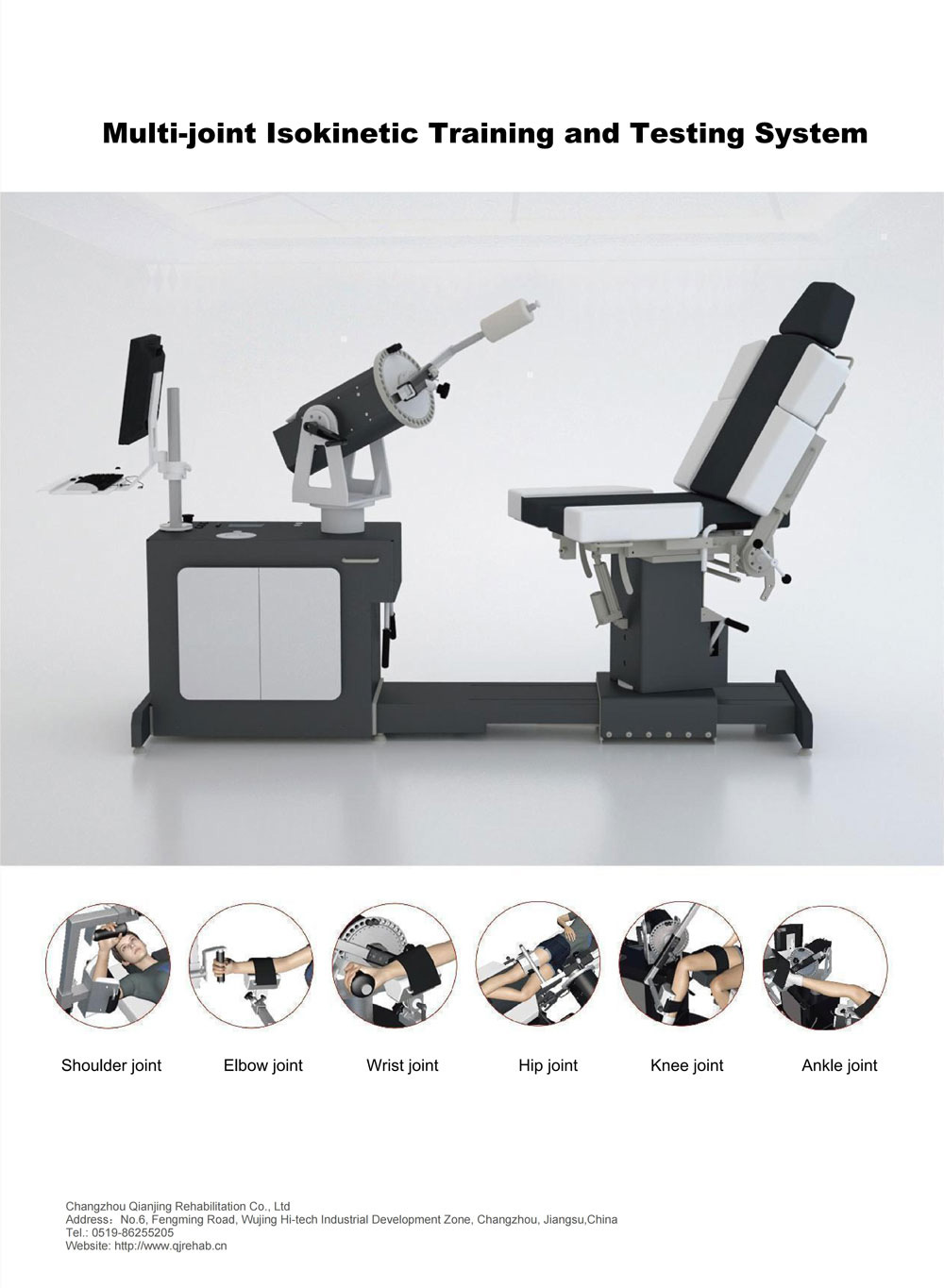
The multi-joint isokinetic training and testing system refers to a system that can maintain a constant movement speed and variable resistance during joint movement. The movement speed is pre-set on the machine. During the test, muscle force only increases muscle strength and torque output without changing the angular velocity during the movement. That is, the movement speed is constant, and the muscles can generate maximum muscle force at any point in the entire movement process. It is a multifunctional device for evaluating muscle function and training muscle strength.
Isokinetic · Isotonic · Isometric · Concentric | Gold Standard for Muscle Assessment & Rehabilitation
The multi-joint isokinetic training and testing system maintains constant movement speed with variable resistance during joint motion. The angular velocity is preset by the device; muscle strength output increases without changing movement speed, allowing maximum muscle force generation at any position throughout the motion range. It serves as a professional multifunctional device for muscle function evaluation and strength training.
Occupying less than 3 square meters with over 50 functional modes, it fully meets whole-body muscle assessment and training demands, delivering an integrated muscle rehabilitation solution.
| Testing Parameter | Clinical Application Significance |
|---|---|
| Peak Torque | Maximum output force of muscle contraction, core index for evaluating muscle strength level. |
| Peak Angle | Joint angle corresponding to peak torque, marking the optimal muscle contraction angle. |
| Endurance Ratio | Reflects muscle fatigue resistance during repeated contraction movements. |
| Left & Right Muscle Balance Ratio | Judges limb strength symmetry; difference over 10% increases joint injury risk. |
| Peak Torque / Weight Ratio | Standardized strength evaluation for cross-individual and cross-group comparison. |
| Torque Acceleration Energy | Evaluates muscle explosive contraction capacity within initial movement stage. |
| Agonist / Antagonist Torque Ratio | Assesses muscle coordination and joint stability to predict latent joint lesions. |
| Average Joint Range of Motion | Quantifies joint movement limitation and provides basis for personalized rehabilitation planning. |
Rehabilitation Medicine Department
Orthopedics & Traumatology
Sports Medicine Department
Sports Colleges & Professional Training Centers
Nervous system injury: Stroke, brain trauma, spinal cord injury, Parkinson's disease
Bone & joint injury: Osteoarthritis, ACL injury, meniscus injury, patellar chondromalacia
Sports population: Strength improvement, explosive power training, return-to-sport assessment
| Product Dimension (L×W×H) | 2100 × 700 × 1650 mm |
| Gross Weight | 350 kg |
| Sampling Frequency | ≥2000 Hz |
| Max Concentric/Eccentric Torque | 630 N·m |
| Max Isotonic Torque | 350 N·m |
| Concentric Angular Velocity | 1 – 500 °/s |
| Eccentric Angular Velocity | 1 – 360 °/s |
| Power Head Electric Lift Range | 0 – 300 mm |
| Seat Safety Load | 135 kg |
| Configuration | 21" HD Monitor, Windows 10 System, 4GB RAM + 256GB SSD |
| Power Supply | 220V / 50Hz, Grounding Required |
This system provides one-stop muscle strength assessment, targeted training and data management solution. It supports automatic report generation, historical data comparison, game-based interactive training and patient file management.
Automatically generate professional assessment reports to support rehabilitation scheme adjustment
Game interactive training improves patient initiative and rehabilitation compliance
Unified user & equipment management platform for medical institutions and training centers


Whatsapp: +86-13812226033
E-mail: info@qjmed.com
ADD: No.6 Fengming Road, Wujin Hi-tech Industrial Development zone, Wujin District, Changzhou, Jiangsu, China


