


What is an Overhead Ceiling Lift for Patients? A Complete Guide
1. Introduction: Understanding Overhead Ceiling Lifts
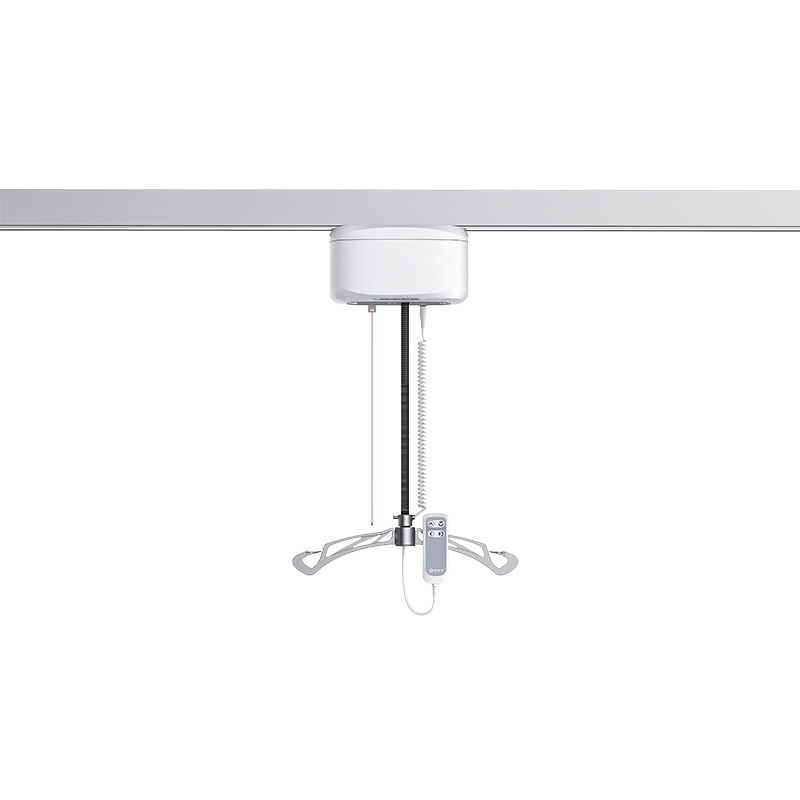
An overhead ceiling lift for patients is a motorized device mounted on ceiling‑mounted tracks that safely lifts, lowers, and transports individuals with limited mobility. Also known as a ceiling patient lift, patient ceiling hoist, or overhead patient lift system, this Overhead Ceiling Track Hoistis widely used in hospitals, nursing homes, rehabilitation centers, and even private homes.
The primary purpose of a ceiling patient lift is to eliminate manual lifting by caregivers. Instead of two or three staff members struggling to move a patient from bed to wheelchair, a single caregiver can operate the lift with a hand control. This reduces the risk of falls for patients and prevents back injuries for staff – a leading cause of occupational disability in healthcare.
Modern overhead lift systems go beyond simple transfer. Many now integrate gait training features, allowing patients to practice walking while being partially supported by the hoist. This combination of safety, efficiency, and rehabilitation makes the overhead ceiling lift an essential tool in patient handling.
2. How Does a Ceiling Patient Lift Work?
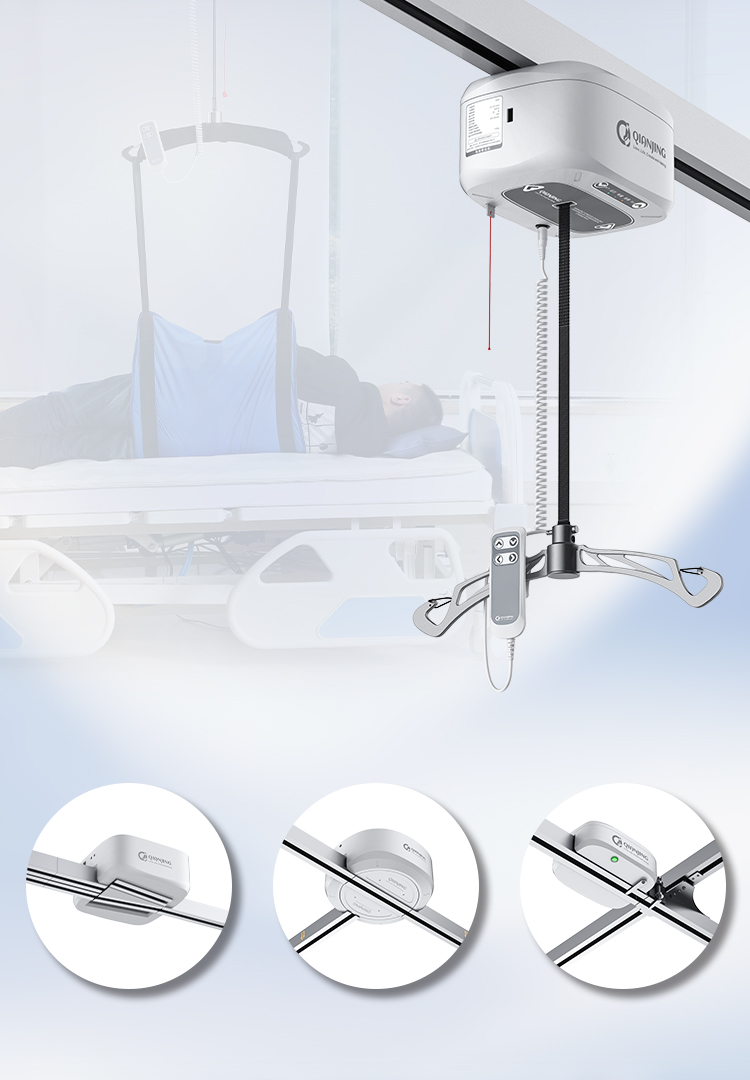
A ceiling patient lift consists of four main components:
Ceiling‑mounted track – available as straight rail, curved rail, or H‑rail systems. Tracks can be configured to cover one room or connect multiple rooms via automatic switching components.
Motorized trolley (machine head) – travels along the track and contains the lifting motor, sensors, and battery backup.
Patient sling – a fabric support that wraps around the patient. Different sling types exist for sitting transfer, lying transfer, walking training, and limb suspension.
Hand control – allows the caregiver to raise, lower, and move the trolley along the track.
How it works:
The caregiver positions the patient in the appropriate sling, attaches the sling to the trolley, and uses the hand control to lift the patient slightly off the bed or chair. The trolley then moves along the track to the desired location (e.g., bathroom, wheelchair, therapy mat). Once in position, the caregiver lowers the patient gently. The entire operation can be performed by one person.
Advanced models include intelligent features such as:
Gait following – the trolley automatically follows the patient during walking training.
Dynamic weight reduction – sensors adjust support in real time based on the patient‘s movement.
Anti‑collision – detects obstacles and stops immediately.
Anti‑fall protection – multiple auto‑lock grades prevent accidental descent.
3. Key Benefits of an Overhead Patient Lift System
For Patients
Safety – Eliminates the risk of falling during manual transfers.
Comfort – Gentle lifting and lowering, often with soft start/stop technology.
Dignity – Patients feel more secure and less dependent on multiple caregivers.
Reduced secondary injury – No pulling or dragging, which is especially important for fragile skin or healing wounds.
For Caregivers
Reduced physical strain – No more bending, lifting, or reaching awkwardly.
Lower injury risk – Back injuries are the #1 occupational hazard in nursing. A ceiling patient lift virtually eliminates that risk.
Efficient 1‑person operation – Tasks that required 2‑3 people can now be done by one.
For Facilities
Labor cost savings – Fewer staff needed for transfers means better resource allocation.
Improved patient outcomes – More frequent transfers and earlier mobilization lead to faster recovery.
Modernization – Installing overhead patient lift systems signals a commitment to safety and quality care.
4. Types of Ceiling Track Hoist Systems
| Type | Description | Best For |
|---|---|---|
| Straight rail | Simple point‑to‑point transfer (e.g., bed to wheelchair). | Small rooms, single purpose. |
| Curved rail | Allows turns around corners or obstacles. | Bathrooms, irregular layouts. |
| H‑rail system | Two parallel rails with a connecting perpendicular rail – covers an entire room. | Rehab halls, large wards. |
| Inter‑room system | Tracks that pass through doorways using automatic switching components. | Connecting bedroom → bathroom → corridor. |
| Freeway (portable) track | Lightweight rail sections that can be moved between rooms. | Facilities not ready for fixed installation. |
Most overhead patient lift systems also offer a choice between transfer‑only models and transfer + gait training models. The latter includes sensors and software that allow the patient to practice walking while being partially supported – ideal for stroke and spinal cord injury rehabilitation.
5. Ceiling Track Hoist vs. Portable Patient Lift: Which is Better?
| Feature | Ceiling Track Hoist | Portable Patient Lift |
|---|---|---|
| Floor space usage | None (track is overhead) | Requires storage space |
| Transfer range | Along installed track (room to room possible) | Anywhere (mobile) |
| Caregivers needed | 1 person | 1‑2 persons |
| Installation | Requires structural mounting | Ready to use out of the box |
| Patient feeling | Smooth, stable, ceiling‑guided | Can feel tippy if not positioned correctly |
| Best for | Fixed locations, high‑frequency transfers | Multiple locations, low‑frequency use |
| Typical weight capacity | 150‑200kg (330‑440lbs) | 150‑200kg (330‑440lbs) |
| Gait training support | Yes (many models) | No |
Verdict: If your facility performs transfers in the same rooms every day (e.g., hospital ward, nursing home), a ceiling track hoist is the superior choice. If you need a lift that moves between different buildings or is used only occasionally, a portable patient lift may be sufficient.
6. Who Can Benefit from a Patient Ceiling Hoist?
A patient ceiling hoist is suitable for a wide range of individuals:
Neurological Conditions
Stroke (hemiplegia)
Cerebral palsy
Spinal cord injury (paraplegia, tetraplegia)
Multiple sclerosis
Parkinson‘s disease
Orthopedic Conditions
Hip or knee replacement (post‑operative)
Lower limb fracture (e.g., femur, tibia)
Amputation (prosthetic training)
Severe arthritis
Geriatric Patients
Age‑related weakness
High fall risk
Prolonged bed rest deconditioning
Bariatric Patients
Patients weighing over 150kg (330lbs) require heavy duty patient lifts. Many ceiling track hoists offer 200kg or even 300kg capacity.
Other
Post‑ICU weakness
Muscular dystrophy
Amyotrophic lateral sclerosis (ALS)
In short, any patient who cannot safely stand or walk independently – or who requires assistance to transfer – can benefit from an overhead ceiling lift.
7. Essential Safety Features of an Overhead Ceiling Lift
When evaluating an overhead patient lift system, look for these mandatory safety features:
Anti‑fall protection – Multi‑level auto‑lock that engages if the lifting belt slips or if descent is too rapid.
Anti‑collision sensor – Detects obstacles (walls, doors, another trolley) and stops movement immediately.
Emergency stop rope – A pull cord that instantly locks the trolley in place.
Power failure support – Built‑in battery that provides at least 12 hours of normal operation after a power outage.
Emergency lift/lower buttons – Long‑press buttons on the control handle for slow, controlled manual operation.
Sling safety locks – Spring‑loaded latches that prevent accidental detachment.
Overload protection – The system should not operate if the patient‘s weight exceeds the rated capacity.
Always verify that the ceiling patient lift is CE marked and ISO 13485 certified. These certifications ensure the device meets international safety and quality standards.
8. How to Choose the Right Ceiling Patient Lift for Your Facility?
Follow this 5‑step decision process:
Step 1: Assess Your Patient Population
How many patients need transfer assistance daily?
What is the average and maximum patient weight?
What types of conditions (neurological, orthopedic, bariatric)?
Step 2: Evaluate Your Building Structure
Ceiling height and construction material (concrete, steel, wood)?
Can the ceiling support the weight of the track + patient?
Room layout – are there obstacles (columns, lights, partitions)?
Step 3: Determine Coverage Needs
Do you need coverage in one room only (e.g., a single ward)?
Or do you need ceiling track hoist between rooms (e.g., bedroom → bathroom → corridor)?
Full‑floor coverage requires H‑rail or networked straight rails.
Step 4: Compare Suppliers
Does the supplier have CE and ISO 13485 certification?
What warranty is offered? (2‑5 years is typical)
Are spare parts available for 10+ years?
Is remote technical support provided?
Step 5: Budget for Installation and Maintenance
Equipment cost + track materials + installation labor
Annual maintenance (track cleaning, motor inspection, battery replacement)
Sling replacement (every 6‑12 months depending on usage)
9. Installation and Maintenance Guide
Installation Process
Structural assessment – An engineer checks ceiling load capacity.
Track design – Custom layout based on room dimensions and transfer paths.
Mounting – Rails are securely bolted to the ceiling structure.
Electrical connection – Power is supplied via the track (full‑rail charging) or separate wiring.
Trolley calibration – Sensors and motors are tested.
Staff training – Caregivers learn how to operate the ceiling patient lift safely.
Most professional suppliers offer turnkey installation – they handle everything from assessment to training.
Maintenance Checklist
Daily – Visually inspect slings for wear or damage. Clean track if debris is visible.
Weekly – Test emergency stop and battery backup.
Monthly – Check for unusual noise from the motor or trolley wheels.
Quarterly – Inspect mounting bolts for tightness.
Annually – Professional service visit (motor, battery, track alignment).
10. Frequently Asked Questions (FAQ)
Q1: How much weight can an overhead ceiling lift support?
A: Standard models support 150‑200kg (330‑440lbs). Heavy‑duty versions can handle up to 300kg (660lbs). Always check the specific model‘s rated capacity.
Q2: Can a ceiling patient lift be installed in a private home?
A: Yes. Many families install a ceiling track hoist for long‑term care, especially in bedrooms and bathrooms. The installation requires professional assessment of ceiling strength.
Q3: How long does battery backup last during a power failure?
A: Most quality systems provide 12+ hours of normal operation. This includes lifting, lowering, and moving along the track.
Q4: Is special training required to operate the system?
A: Basic training is recommended (usually 1‑2 hours). The hand control is intuitive, but caregivers must learn proper sling attachment and emergency procedures.
Q5: Can the system connect multiple rooms?
A: Yes. Using automatic track switching components (4‑way, 3‑way, Y‑shaped, or H‑shaped transitions), the trolley can move from one room to another without manual intervention.
Q6: What types of slings are available?
A: Common sling types include: sitting shift sling (for toilet/bath), horizontal transfer sling (for lying transfer), walking training sling (adult/child), and suspended sling (for limb traction).
Q7: How often should slings be replaced?
A: Inspect slings before each use. Replace every 6‑12 months or immediately if you see fraying, stretched straps, or broken stitching.
Q8: Is an overhead ceiling lift covered by insurance?
A: In many countries, ceiling patient lifts may be covered under Durable Medical Equipment (DME) benefits for home use. For facilities, it is typically a capital expense. Check with your local provider.
11. Conclusion: Is an Overhead Ceiling Lift Right for You?
An overhead ceiling lift for patients is more than a transfer device – it is an investment in safety, efficiency, and human dignity. For healthcare facilities, it reduces staff injuries, lowers labor costs, and improves patient outcomes. For home caregivers, it provides peace of mind and protects family members from injury.
If your daily routine involves lifting or transferring a person with limited mobility – whether in a hospital, nursing home, rehab center, or private residence – a ceiling patient lift is likely the right solution.

