




What Is Limb Linkage Training? How the Healthy Side Drives the Affected Side
After a stroke, one side of the body often keeps its strength while the other side struggles to move, and therapy halls fill with patients who can use one hand but not both together. Limb linkage training answers exactly this gap: it couples the arms and legs into one coordinated movement so that the healthy side drives the affected side through every cycle. This guide explains what the method is, how a linkage trainer applies it, which patients it serves and which specifications deserve attention before purchase.
Key Takeaways
Limb linkage training couples the upper and lower limbs of both sides into one synchronized cyclic movement, so the healthy side leads the affected side instead of the affected side working alone.
The method builds on motor relearning: repeated, coordinated and task-specific movement patterns stimulate the nervous system to rebuild control lost after stroke, brain injury or spinal cord damage.
A linkage trainer combines passive, assisted and active modes, resistance adjustment and vital-sign monitoring in one machine, covering patients from early bed-bound stages to active recovery.
Specification points that decide clinical value include resistance levels, synchronized four-limb drive, heart rate and blood oxygen protection, seat adjustability and evaluation reporting.
The equipment serves hospitals, rehabilitation centers, nursing homes, community programs and home training, with compact models designed for non-clinical spaces.
What Limb Linkage Training Means in Rehabilitation
Limb linkage training is a rehabilitation method in which the two arms and the two legs are mechanically coupled into one rhythmic, cycling-like movement pattern. In plain terms, the machine links four limbs together the way healthy walking links them naturally: when one arm pushes, the opposite leg steps forward, and the whole body follows a coordinated rhythm. A patient who cannot initiate movement on the affected side still participates, because the moving limbs carry the passive limbs through the same pattern.
The idea matters because isolated joint exercise does not reflect how people actually move. Daily activities such as walking, standing up or carrying a tray require both sides of the body to cooperate in a fixed sequence. Rehabilitation research and clinical guidelines on stroke rehabilitation, including the guidance published for the United Kingdom health system on stroke rehabilitation in adults, consistently emphasize repetitive, task-specific and coordinated practice as the basis of motor recovery. Limb linkage training packages that principle into equipment a therapy department can schedule and measure.
The Four-Limb Coordination Principle
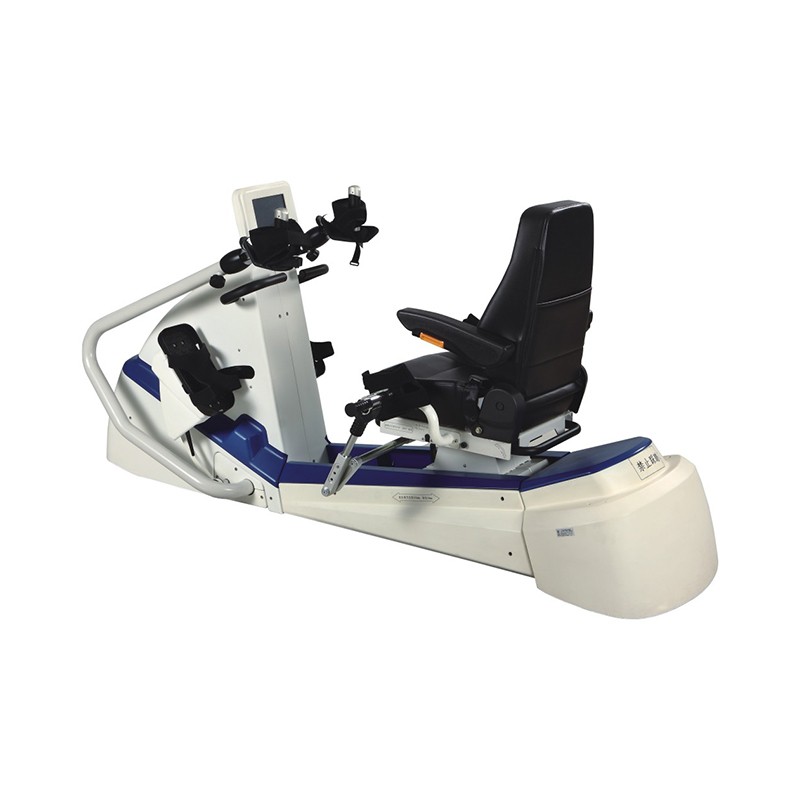
In a typical session, the patient sits in an adjustable seat, grips the handles and places the feet on the pedals. The drive system synchronizes shoulders, elbows, hips and knees into one continuous cycle that resembles natural gait mechanics. This four-limb pattern does three jobs at once: it mobilizes joints through a controlled range, it loads muscles against adjustable resistance, and it retrains left-right coordination that neurological injury often disrupts. Because the pattern repeats identically every cycle, the nervous system receives the same structured stimulus hundreds of times per session, which is precisely the repetition that motor relearning requires.
Why Coordinated Movement Supports Motor Relearning
Neurological rehabilitation works on a principle often described as neuroplasticity: the nervous system can rebuild movement pathways when it receives frequent, repeated and meaningful stimulation. Passive limbs moved by healthy ones still send position and movement signals to the brain, so even a patient with severe weakness receives structured sensory input from the affected side during every cycle. Over sessions, this input supports reduction of spasticity, preservation of joint range and prevention of muscle atrophy while strength returns. The overview of post-stroke recovery published by the United States national neurological research institute describes the same logic of repeated practice and early, structured mobilization after stroke.
How the Healthy Side Drives the Affected Side
The phrase describes the core working mechanism of a linkage trainer. Published product documentation for this equipment category describes two linked capabilities: the healthy side driving the affected side, and one limb driving three limbs. Mechanically, when the patient actively pushes with any able limb, the connecting rod system transmits that force to the coupled limbs, so the weaker side completes the same trajectory without independent effort. When even active pushing is not yet possible, a motor drives the whole linkage instead, and the patient's limbs are carried through the pattern passively.
This graded handover is the practical strength of the method. Early after injury, the motor provides all the movement and the patient focuses on comfort, alignment and tolerance. As control returns, the patient pushes harder and the motor assistance fades into the background. Later in recovery, resistance increases and the machine becomes a strength and endurance trainer for all four limbs. One device therefore follows the patient across the entire recovery pathway instead of being replaced at each stage.
Passive, Assisted and Active Modes in One Device
Modern linkage equipment formalizes this progression into three selectable modes. Passive training moves the limbs entirely by motor at a set angle and speed, used for early-stage patients, severe spasticity or circulation maintenance. Assisted training, sometimes called active-passive mode, lets the motor support an incomplete effort and can switch automatically between passive and active behavior as the patient tires or recovers within a session. Active training removes motor help and applies adjustable resistance, from gentle mobilization to strength work. Published systems add angle and speed limits derived from an advance evaluation so that passive ranges stay within what the limb tolerates, which reduces the risk of strain from excessive settings.
What Changes Between Early and Late Recovery Stages
The same machine serves different clinical goals by adjusting three variables: how much the motor contributes, how much resistance opposes the movement and how long each session runs. Early-stage sessions emphasize passive cycling at low speed for circulation and spasticity management. Middle-stage sessions alternate assisted and active intervals as strength fluctuates. Late-stage sessions target endurance and symmetry, with therapists using the recorded data to compare left-right contribution over weeks. Recovery of walking itself usually progresses to dedicated gait equipment, a transition examined in a separate article on choosing a reliable robotic gait trainer manufacturer.
Inside a Limb Linkage Rehabilitation Training Device
Understanding the hardware helps buyers compare models beyond brochures. A linkage trainer combines mechanical linkage, a control system, safety monitoring and adjustability features, and each element has concrete, checkable specifications.
Structural and Ergonomic Features
Published configurations describe an electrically adjustable seat that moves forward and backward by roughly 340 millimeters so the distance matches patient height and leg length, control buttons on both sides of the seat, a one-touch brake that locks the limb connecting rods during mounting and dismounting, and a quick handle adjustment covering about 400 millimeters of travel with rotation from 20 degrees on the left to 20 degrees on the right. Footrest angle adjusts up to about 23 degrees, the seat offers eight horizontal tilt levels, and the backrest reclines to 160 degrees for patients who cannot sit fully upright. A welded high-strength frame and an antibacterial, breathable cushion complete the clinical package, with rated patient loads around 135 kilograms on published models and a usable height range from about 150 to 190 centimeters.
Monitoring and Safety Protection
Because four-limb cycling raises heart rate quickly, safety monitoring is a defining feature rather than an accessory. Published systems include a built-in heart rate module that displays the value in real time and alerts when load becomes excessive, plus a finger-clip blood oxygen and pulse sensor that feeds readings to the training screen; when values leave the configured safe range, the device stops training automatically. For elderly patients and anyone with cardiovascular comorbidity, this automatic protection converts an exercise prescription into a monitored therapy session.
Training Programs, Games and Evaluation Reports
Beyond the three basic modes, published models list nine built-in cardiopulmonary training modes, including hill-climb, interval and constant-power patterns, with the option to combine modes, games and parameters into customized programs stored for each patient. Game-based training displays progress on screen so that repetitive cycling becomes a visible challenge, which measurably improves engagement in long rehabilitation courses. The device records session data and generates evaluation reports, giving therapists objective documentation of range, resistance and symmetry over time. The full equipment category, including both control configurations described below, is presented on the linkage trainer product range page.
The devices below cover the linkage trainer itself and the two adjacent limb-training categories most often configured alongside it in a therapy hall.
Limb Linkage Trainer E-SLD-01
Four-limb synchronized training with the healthy side driving the affected side; 15 resistance levels, passive and active dual mode, real-time heart rate monitoring, CE certified.
View Product
Active Passive Trainer AP-ZXQ-05
Passive, active and motor-assisted training for arms and legs; 8 resistance gears, 12-position seat, seat load 2000 N (about 204 kg); wheelchair fixation hook for seated training.
View Product
Limb Training Cycle AP-ZXQ-09
Supine-position training for bedridden patients after stroke, joint dysfunction or surgery; 8 resistance gears, 12-position adjustment, seat load capacity 2000 N (about 204 kg).
View ProductRequest a Configuration Recommendation
A short description of the patient group and therapy space is enough for a rehabilitation equipment manufacturer to propose a suitable linkage trainer configuration and quotation.
Clinical Indications and Application Settings
Published indications concentrate on conditions that weaken or desynchronize the limbs. Understanding where the method fits helps therapy departments decide between linkage training and alternative equipment.
Conditions and Patient Groups
Suitable conditions listed for this equipment family include stroke and hemiplegia, cerebral palsy, traumatic brain injury, spinal cord injury, orthopedic and ligament-repair recovery, and limb movement dysfunction from neurological disease. The same list serves elderly users with muscle atrophy and reduced mobility, patients with poor balance and walking difficulty, and sub-health adults who need coordinated limb exercise. For conditions such as cerebral palsy, the condition overview published by the United States national neurological research institute notes that coordinated, repetitive movement therapy is a mainstay of long-term management, which matches the training pattern this equipment provides.
From Hospital Wards to Home Training
Application settings documented for the category span rehabilitation medicine departments, orthopedics, neurology and geriatrics wards, rehabilitation hospitals, nursing homes, community health centers, special education institutions and family home programs. Home suitability depends on footprint and operation simplicity: published models are described as compact with simple controls that do not require professional supervision for daily sessions, while clinical models add evaluation, patient management and reporting functions used by therapy teams. Departments commonly pair linkage trainers with balance and evaluation systems to complete the therapy hall, and the range of limb linkage and limb training equipment shows how the models are positioned for each setting.
Specification and Selection Reference for Limb Linkage Training Equipment
The two tables below condense published data into comparison form: the first lists checkable specifications of the E-SLD-01 linkage trainer, and the second compares the two control configurations offered for the product family.
| Specification Item | Published Value (E-SLD-01) | Why It Matters in Limb Linkage Training |
|---|---|---|
| Resistance adjustment | 15 levels | One machine covers passive early-stage work through active strength training |
| Training mode | Upper and lower limb synchronous linkage, passive and active dual mode | Healthy side drives the affected side across recovery stages |
| Monitoring | Real-time heart rate detection and display | Automatic overload alert protects cardiovascular safety |
| Frame and cushion | High-strength welded metal frame; antibacterial, breathable cushion | Stability and hygiene under daily clinical use |
| Applicable user height | About 150 cm to 190 cm | One configuration serves most adult patients |
| Maximum load capacity | 135 kg | Defines the patient population a single unit can serve |
| Certification | CE and ISO certified | Supports procurement compliance in regulated markets |
| Application scenes | Hospital, nursing home, community center, home rehabilitation | Department planning and home programs use the same device family |
| Configuration Item | E-SLD-01 | E-SLD-02 |
|---|---|---|
| Control system | LCD touch screen | Tablet computer |
| Core functions | Limb linkage training, system settings | Training, rehabilitation assessment, patient management, training reports, games, settings |
| Training programs | Active, passive, active-passive modes | Adds nine cardiopulmonary modes and customizable combined programs |
| Overall dimensions | 1820 × 875 × 1230 mm | 1820 × 875 × 1230 mm |
| Product weight | 136 kg | 136 kg |
| Handle adjustment | 400 mm travel; 20 degrees left to 20 degrees right rotation | 400 mm travel; 20 degrees left to 20 degrees right rotation |
| Seat adjustment | 340 mm front to rear; 8 horizontal tilt levels; backrest to 160 degrees | 340 mm front to rear; 8 horizontal tilt levels; backrest to 160 degrees |
| Suitable buyer profile | Therapy rooms that need straightforward operation | Departments that document evaluation and patient progress |
Compare Models With Full Documentation
Specification sheets, certificate numbers and demonstration arrangements are available for both control configurations before any purchase decision.
Conclusion
Limb linkage training turns a scattered set of single-joint exercises into one coordinated, measurable pattern in which the healthy side drives the affected side through every cycle. The method matches what neurological rehabilitation research asks for: repetition, coordination and graded progression from passive movement to active strength work. A limb linkage rehabilitation training device implements the method with selectable modes, 15-level resistance, vital-sign protection and evaluation reporting, serving the same patient from the earliest passive sessions to independent active training. Buyers who compare resistance range, monitoring functions, adjustability and reporting capability in writing will find the differences between suppliers concrete rather than cosmetic.
For readers looking for a dependable limb linkage training manufacturer, QianJing Rehabilitation (Changzhou, founded in 1996, 169 patent certificates, participant in drafting 7 national and industry standards, equipment in service at more than 2000 medical institutions across 85+ countries, OEM and ODM supported, factory audits and third-party inspections welcomed) publishes complete specifications and verifiable certificates for its linkage trainer range at www.qjrehab.cn.
FAQ
What is limb linkage training in simple terms?
It is a rehabilitation method that links both arms and both legs into one synchronized, cycling-like movement, so the healthy limbs lead the weaker limbs through the same coordinated pattern during every session.
How does the healthy side drive the affected side in a training session?
A connecting rod system couples all four limbs, so force from any able limb moves the affected limbs through the same trajectory. When no active effort is possible yet, a motor drives the linkage instead, and assistance reduces gradually as strength returns.
Which patients benefit from a limb linkage rehabilitation training device?
Published indications cover stroke and hemiplegia, cerebral palsy, brain trauma, spinal cord injury, orthopedic and ligament-repair recovery, elderly users with muscle atrophy, and patients with poor balance or walking difficulty.
Is a limb linkage trainer suitable for home rehabilitation?
Published configurations describe compact floor-space requirements and simple operation intended for daily home sessions, while clinical versions add assessment, patient management and reporting functions for therapy teams. Suitability for an individual patient should follow a therapist's recommendation.
What safety monitoring is built into the equipment?
A heart rate module displays values in real time and alerts on excessive load, and a finger-clip blood oxygen and pulse sensor stops training automatically when readings leave the configured safe range. Advance evaluation also limits passive movement angles to prevent strain.
How is limb linkage training different from an ordinary rehabilitation bike?
An ordinary bike exercises limbs separately, usually the legs alone. A linkage device synchronizes shoulders, elbows, hips and knees in one gait-like pattern, adds healthy-side driving of the affected side, and combines it with resistance levels, vital-sign protection and evaluation reporting.
References and Data Notes
UK clinical guideline on stroke rehabilitation in adults — basis for repetitive, task-specific and coordinated practice in motor recovery (nice.org.uk, accessed 2026-11-13).
Post-stroke recovery and rehabilitation overview from the United States national neurological research institute — context for repeated practice and early mobilization (ninds.nih.gov, accessed 2026-11-13).
Cerebral palsy condition overview from the United States national neurological research institute — context for long-term coordinated movement therapy (ninds.nih.gov, accessed 2026-11-13).
Data notes: all device specifications (15 resistance levels, healthy-side driving and one-limb-driving-three-limbs mechanism, heart rate and blood oxygen pulse monitoring with automatic stop, nine cardiopulmonary modes, dimensions 1820 × 875 × 1230 mm, weight 136 kg, handle adjustment 400 mm, handle rotation 20 degrees each side, footrest angle up to 23 degrees, seat travel 340 mm, seat tilt 8 levels, backrest to 160 degrees, E-SLD-01 and E-SLD-02 control configurations, 135 kg load, 150 to 190 cm height range) are taken from the published pages for the E-SLD-01 model and the limb linkage equipment category on qjrehab.cn, accessed 2026-11-13. Company figures (founding year 1996, 169 patent certificates, 7 national and industry standards, 2000+ medical institutions, 85+ countries) are published on the official company profile page. Clinical principles follow the cited public health guidance rather than any manufacturer claim.

