


Overhead Ceiling Track Hoist Guide 2026

An overhead ceiling track hoist is a motorized patient lifting and transfer system designed to help healthcare professionals safely move and support patients with limited mobility. Installed along an overhead track, the lifting unit can raise, lower, and move patients between different locations while reducing the physical demands of manual patient handling.
Unlike traditional mobile patient lifts, an overhead lift system uses the available space above the floor. Depending on the track configuration, it can support transfers between beds, wheelchairs, bathrooms, treatment areas, and rehabilitation spaces.
Modern ceiling track hoist systems can also provide more than basic patient transfer. Intelligent systems can support gait training, dynamic weight reduction, standing exercises, and other rehabilitation activities.
For hospitals, rehabilitation centers, nursing homes, elderly care facilities, and other healthcare environments, understanding the different types, functions, track configurations, and selection factors is essential when planning an overhead patient lift system.
This guide explains how an overhead ceiling track hoist works, its main benefits and components, available track configurations, applications, and the key factors buyers should consider when selecting an overhead lift system.
Table of Contents
What Is an Overhead Ceiling Track Hoist?
How Does an Overhead Ceiling Track Hoist Work?
What Are the Benefits of an Overhead Lift System?
Types of Ceiling Track Hoist Systems
Key Components of an Overhead Patient Lift
Functional Slings for Different Patient Needs
Intelligent Features for Gait and Rehabilitation Training
How to Choose an Overhead Ceiling Track Hoist
Where Are Overhead Ceiling Track Hoists Used?
Patient Groups That May Benefit from an Overhead Patient Lift
Overhead Ceiling Track Hoist vs. Mobile Patient Lift
Safety Considerations for an Overhead Lift System
Installation and Track Planning
Intelligent Management for Rehabilitation Training
Why Choose QJ Rehab's Overhead Ceiling Track Hoist?
Frequently Asked Questions
What Is an Overhead Ceiling Track Hoist?
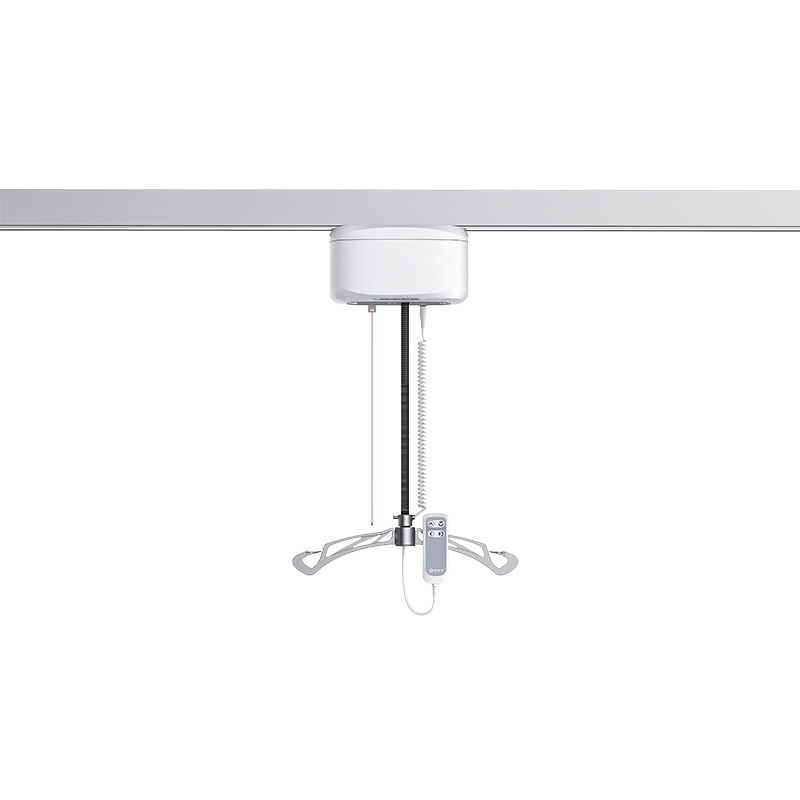
An overhead ceiling track hoist is an electrically powered patient lifting system that operates on an overhead rail. The system typically consists of an overhead track, motorized lifting unit, control system, and patient support sling.
The lifting unit provides vertical movement for lifting and lowering the patient and horizontal movement along the track. With an appropriate track layout, patients can be transferred between multiple locations without requiring caregivers to manually move a heavy lifting device across the floor.
An overhead ceiling lift hospital can be used for both daily patient handling and rehabilitation. Depending on the configuration and accessories, it can support seated transfers, horizontal transfers, standing exercises, walking training, and gait rehabilitation.
QJ Rehab's overhead lift system is designed for hospitals, rehabilitation centers, nursing homes, elderly care facilities, and other professional healthcare environments. The system combines flexible track configurations with intelligent lifting and rehabilitation functions.
How Does an Overhead Lift System Work?
An overhead lift system uses a motorized machine head that travels along an installed ceiling track.
The basic operating process includes:
The patient is positioned and secured with an appropriate sling.
The lifting unit raises the patient to the required height.
The motorized head moves along the overhead track.
The patient is transferred to the designated location.
The lifting unit lowers the patient safely.
Depending on the track design, the ceiling lift system can provide straight-line, curved, or multi-directional movement.
QJ Rehab supports straight rails, curved rails, and H-rail configurations, together with different track-changing solutions. These include four-way transition, three-way transition, Y-shaped track changes, and H-shaped track changes. This allows the overhead track system to be configured according to different room layouts and patient movement requirements.
What Are the Benefits of an Overhead Ceiling Track Hoist?
Safer Patient Transfers
An overhead patient lift provides controlled lifting and movement during patient transfers. This can help reduce the physical risks associated with manual handling, particularly when assisting patients who cannot stand or walk independently.
Reduced Caregiver Strain
Repeated manual lifting and repositioning can place significant physical demands on caregivers. An overhead lift system transfers much of the lifting and movement work to a powered system, helping reduce caregiver workload during routine patient handling.
Better Use of Floor Space
Because the lifting unit travels above the floor, an overhead ceiling track hoist does not require the same floor footprint as a mobile patient lift.
This can be particularly useful in rehabilitation rooms, patient rooms, and other environments where floor space is limited.
Flexible Transfer Routes
A properly designed track system can connect multiple patient-care locations.
Typical transfer routes may include:
Bed to wheelchair
Wheelchair to toilet
Bed to bathroom
Bed to treatment area
Treatment area to rehabilitation equipment
Support for Rehabilitation
An intelligent overhead lift system can also support rehabilitation rather than being limited to patient transfer.
QJ Rehab's system incorporates intelligent gait following and dynamic weight reduction functions, allowing the system to provide different levels of support during mobility and gait training.
Types of Ceiling Track Hoist Systems
The appropriate ceiling track hoist configuration depends on the room structure, transfer routes, and rehabilitation requirements.
Straight Track
A straight track is suitable for simple transfer routes where two or more primary locations are positioned along a relatively direct path.
Common applications include:
Bed-to-wheelchair transfer
Bed-to-treatment-area transfer
Straight-line walking training
Curved Track
Curved tracks allow the lifting unit to follow a curved movement path.
They can be useful when rooms, corridors, or patient-care areas cannot be connected efficiently with a straight rail.
H-Track System
An H-track system provides wider coverage within a defined room.
It can allow the lifting unit to access multiple points and can be suitable for rehabilitation rooms where patients need to move between beds, treatment areas, and training zones.
Multi-Directional Track System
More complex healthcare environments may require multiple movement directions.
Track-changing systems can connect different rails and allow the lifting unit to move between routes.
QJ Rehab provides four-way and three-way transitions as well as Y-shaped and H-shaped track changes for different system configurations.
Key Components of an Overhead Patient Lift
A complete overhead patient lift includes more than the motorized lifting unit.
Overhead Track
The track provides the movement route for the lifting unit. Its configuration determines where the patient can be transferred and how much of the room can be covered.
Motorized Lifting Unit
The motorized machine head provides powered lifting, lowering, and movement along the track. For intelligent rehabilitation systems, the lifting unit can also interact with sensors and control systems to adjust movement and support according to patient activity.
Patient Sling
The sling provides support between the patient and lifting unit. Different transfer and rehabilitation tasks require different sling designs.
Control System
The control system allows caregivers or rehabilitation professionals to operate the lifting unit and manage the required movement and training functions.
Functional Slings for Different Patient Needs
The choice of sling is an important part of an overhead lift system because different patients and activities require different forms of support.
Sitting Transfer Sling
A sitting transfer sling is designed for seated patient transfers and can be used for applications such as wheelchair transfers, bathing, and toileting.
QJ Rehab's sitting transfer sling uses a hip-open design intended to facilitate positioning and transfer.
Horizontal Transfer Sling
A horizontal transfer sling is designed for patients who need to remain in a lying position during transfer. It can provide broader body support for horizontal movement.
Walking Training Sling
A walking training sling is designed specifically for gait and walking rehabilitation.
QJ Rehab provides adjustable walking training sling options for adult and pediatric applications and uses a segmented design to help reduce pressure around the groin area.
Suspended Sling
A suspended sling can be used for limb traction and rehabilitation treatment applications.
Selecting the correct sling should take into account the patient's condition, body position, transfer requirements, and rehabilitation objectives.
Intelligent Features for Gait and Rehabilitation Training
A modern overhead track lift can provide more than lifting and transfer assistance.
Intelligent Gait Following
QJ Rehab's intelligent overhead lift system can identify walking direction and speed and automatically adjust movement parameters so that the lifting unit follows the patient's movement.
This function is designed to provide synchronized support during gait training while helping maintain more stable body positioning.
Dynamic Weight Reduction
Patients at different stages of rehabilitation may require different levels of body-weight support.
The system uses multiple sensors to detect changes in the patient's center of gravity and dynamically adjust weight reduction to maintain an appropriate level of support.
Three Training Modes
The system provides three rehabilitation modes for different stages of training:
| Training Mode | Main Application |
|---|---|
| Early Training Suspension Mode | Limb stretching and early-stage mobility training |
| Mid-Term Fixed-Point Mode | Standing, squatting, balance, and related training |
| Late Free Mode | Walking, stairs, slopes, and obstacle-crossing training |
This approach allows the level of assistance to change as the patient's mobility and rehabilitation ability develop.
How to Choose an Overhead Ceiling Track Hoist
Selecting an overhead ceiling track hoist should begin with the patient's needs and the intended application.
1. Assess Patient Mobility
Consider whether the patient:
Requires full-body support
Can partially bear weight
Can stand with assistance
Can walk with support
Requires gait rehabilitation
Needs seated or horizontal transfer
Different mobility levels may require different lifting modes and slings.
2. Define the Transfer Requirements
Determine which locations need to be connected.
For example:
Bed → Wheelchair → Bathroom
or:
Treatment Area → Walking Area → Rehabilitation Equipment
The transfer route directly affects the required track configuration.
3. Select the Track Configuration
Choose between straight, curved, H-track, or multi-directional configurations according to the room layout.
For larger rehabilitation spaces, a full-room track configuration can provide broader coverage.
4. Select the Appropriate Sling
The sling should match the patient's body position and intended activity.
Sitting transfer → sitting transfer sling
Lying transfer → horizontal transfer sling
Walking rehabilitation → walking training sling
Traction or suspension → suspended sling
5. Consider Rehabilitation Functions
If the system will be used for rehabilitation, consider whether the facility requires:
Gait following
Dynamic weight reduction
Standing training
Balance training
Walking training
Stair training
Slope training
6. Evaluate the Installation Environment
Before installation, consider:
Ceiling structure
Room dimensions
Ceiling height
Bed locations
Wheelchair access
Bathroom locations
Rehabilitation equipment
Required transfer routes
Maintenance access
A properly planned track layout can improve room coverage and system usability.
Where Are Overhead Ceiling Track Hoists Used?
An overhead patient lift can be used in a variety of healthcare and rehabilitation environments.
Hospitals
Overhead lift systems can support routine patient transfers between beds, wheelchairs, bathrooms, treatment areas, and other locations.
Rehabilitation Centers
Rehabilitation centers can use overhead track systems for both patient transfer and gait training.
The combination of overhead support and dynamic weight reduction can provide controlled assistance during mobility rehabilitation.
Nursing Homes and Elderly Care Facilities
Patients with reduced strength, balance, or mobility may require regular assistance with transfers.
An overhead ceiling lift can provide consistent support while reducing caregiver handling demands.
Physical Therapy Rooms
An overhead track lift can be integrated into rehabilitation areas to support standing, walking, balance, and other mobility exercises.
Rehabilitation Halls
Larger rehabilitation spaces can use customized track configurations to provide wider movement coverage.
Patient Groups That May Benefit from an Overhead Patient Lift
An overhead lift system may be used to support patients with different mobility and rehabilitation needs, including:
Stroke rehabilitation
Cerebral palsy rehabilitation
Spinal cord injury rehabilitation
Joint replacement recovery
Fracture recovery
Lower-limb dysfunction
Prosthetic users
Elderly patients
Frail patients
Bedridden patients
Patients requiring assisted mobility
The specific lifting method, sling, and rehabilitation program should be selected according to the patient's clinical condition and professional assessment.
Overhead Ceiling Track Hoist vs. Mobile Patient Lift
Both overhead and mobile patient lifts can assist with patient transfers, but they are designed for different environments.
| Feature | Overhead Ceiling Track Hoist | Mobile Patient Lift |
|---|---|---|
| Movement | Along an overhead track | Across the floor |
| Floor space | Minimal equipment footprint | Requires floor space |
| Transfer route | Can be designed for multiple locations | Depends on floor maneuverability |
| Installation | Requires track installation | Generally no permanent track |
| Room coverage | Can provide customized room coverage | Limited by floor movement |
| Rehabilitation use | Can support transfer and gait training | Primarily transfer focused |
| Best suited for | Hospitals, rehab centers, nursing homes | Flexible point-to-point transfers |
An overhead system can be particularly suitable when patient transfers are frequent or when the facility needs an integrated transfer and rehabilitation solution.
A mobile patient lift may be more suitable when permanent track installation is not practical or when equipment needs to be moved between different rooms.
Safety Considerations for an Overhead Lift System
Safety should be considered during system selection, installation, operation, and maintenance.
QJ Rehab's overhead ceiling track hoist incorporates multiple safety functions, including:
Anti-collision protection
Anti-fall protection
Emergency braking
Emergency lifting and lowering controls
Battery backup
The system also includes a battery designed to support normal use for at least 12 hours after power interruption, according to the product information.
Healthcare staff should receive appropriate training before operating the equipment. The track, lifting unit, sling, and safety functions should also be inspected and maintained according to applicable requirements and the manufacturer's instructions.
Installation and Track Planning
The performance of a ceiling hoist track system depends heavily on appropriate planning.
Before installation, healthcare facilities should evaluate:
Room dimensions
Ceiling and structural conditions
Patient bed positions
Transfer destinations
Rehabilitation equipment
Required movement routes
Track configuration
Patient access and caregiver workflow
Maintenance requirements
Future expansion needs
For larger healthcare projects, customized track layouts can connect multiple areas and improve the use of available space.
QJ Rehab supports personalized track configuration, including full-room T-track and H-track solutions, as well as multi-area connection and full-floor coverage planning.
Intelligent Management for Rehabilitation Training
For rehabilitation applications, an overhead track lift can also become part of a digital rehabilitation management system.
User Management
Patient and user information can be organized within individual profiles.
Training Process Management
Training equipment, training modes, time, and operating status can be monitored.
Training Data Statistics
The system can generate training reports and support comparisons between different training sessions.
Device and Data Management
Equipment status and usage information can be centrally managed and visualized.
These functions can help rehabilitation professionals organize training processes and monitor rehabilitation activities more efficiently.
Why Choose QJ Rehab's Overhead Ceiling Track Hoist?
QJ Rehab's overhead ceiling track hoist combines patient transfer, mobility assistance, and rehabilitation functions within one overhead system.
The solution supports flexible track configurations, including straight, curved, and H-rail systems, together with different track-changing options and functional slings. It also incorporates intelligent gait following, dynamic weight reduction, multiple training modes, and multiple safety protection functions.
For healthcare facilities with different room layouts and rehabilitation requirements, the system can be configured according to the intended transfer routes, patient mobility levels, and training applications.
QJ Rehab also provides rehabilitation equipment and integrated rehabilitation solutions for hospitals, nursing homes, elderly care facilities, and other healthcare institutions.
Frequently Asked Questions
What is an overhead ceiling track hoist?
An overhead ceiling track hoist is a motorized patient lifting and transfer system that moves along an overhead rail. It can lift, lower, and move patients between different locations while reducing the physical workload associated with manual patient handling.
How does an overhead patient lift work?
An overhead patient lift uses a motorized lifting unit connected to an overhead track. A suitable sling supports the patient while the lifting unit provides controlled vertical and horizontal movement along the track.
What is a ceiling track hoist used for?
A ceiling track hoist can be used for patient transfers, repositioning, daily care, standing assistance, walking training, and other rehabilitation applications, depending on the system configuration and accessories.
Can an overhead ceiling lift be used for gait training?
Yes. Intelligent overhead lift systems can provide support during gait rehabilitation. QJ Rehab's system includes intelligent gait following and dynamic weight reduction functions and provides different training modes for different stages of rehabilitation.
What types of tracks are available for an overhead lift system?
Common configurations include straight rails, curved rails, and H-rails. More complex systems can use three-way or four-way transitions and Y-shaped or H-shaped track changes.
What types of slings are available?
Depending on the application, options include sitting transfer slings, horizontal transfer slings, walking training slings, and suspended slings. Adult and pediatric walking training sling options are also available.
What is the difference between an overhead ceiling lift and a mobile patient lift?
An overhead ceiling lift travels along a fixed overhead track, while a mobile patient lift is moved across the floor. Overhead systems can save floor space and provide customized movement routes between multiple locations.
Can an overhead ceiling track system connect multiple rooms?
Yes. With an appropriately designed modular track system and track-changing components, an overhead lift system can connect different areas such as patient rooms, bathrooms, corridors, and rehabilitation spaces.
How do I choose an overhead ceiling track hoist?
Consider the patient's mobility level, transfer requirements, room layout, track configuration, sling type, rehabilitation functions, safety requirements, and installation environment. For larger projects, a customized track plan should be developed according to the facility's workflow.
Conclusion
An overhead ceiling track hoist can provide more than basic patient lifting. With the right track configuration, sling, control system, and rehabilitation functions, it can support patient transfers, daily mobility assistance, gait training, and progressive rehabilitation.
When selecting an overhead lift system, healthcare facilities should consider patient needs, transfer routes, room structure, track coverage, sling requirements, safety features, and future rehabilitation applications.
QJ Rehab provides customizable overhead patient lift and ceiling track hoist solutions designed for hospitals, rehabilitation centers, nursing homes, and elderly care facilities.

