


Best Ceiling Hoist Systems for Elderly Rehabilitation and Care
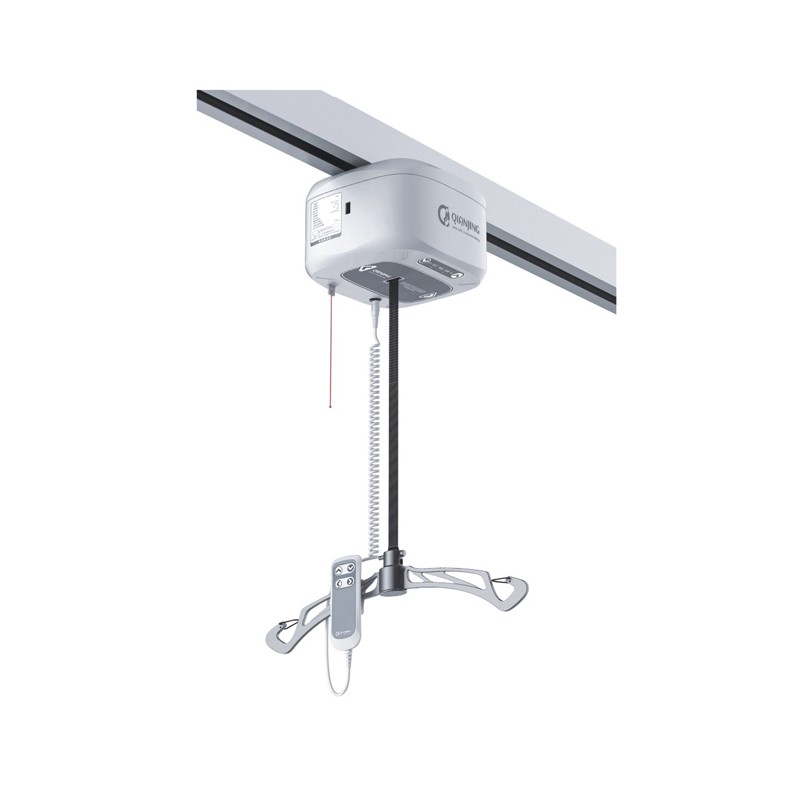
For 2026, the best ceiling lifts for elderly rehabilitation and care include the GoLift, Liko FreeSpan SR, Maxi Sky 440, and the QianJing Overhead Ceiling Track Hoist. These top ceiling track hoists give safer transfers, less strain for caregivers, and more dignity for users. A well-picked ceiling lift protects both the patient and the nurse during every move. You will also see that ceiling lifts free up floor space in small rooms. This guide helps you compare weight capacity, ease of use, installation needs, safety features, and overall value. You will learn how a ceiling hoist rehabilitation system helps with mobility equipment training, standing, and walking practice at home or in a care facility.
Key Takeaways
Ceiling lifts help move patients more safely and easily for both the patient and the person giving care.
Pick a lift that can hold the right amount of weight for what the user needs.
Fixed lifts work best for long-term use, while portable lifts offer more flexibility.
Check for safety features such as emergency brakes and backup batteries.
Talk to a professional to make sure the hoist is installed correctly and fits your room.
What to Look For in Ceiling Lifts
A ceiling lift keeps you and your caregiver safer. These systems often work best for moving someone who has trouble getting around. A ceiling track hoist system frees up floor space and lowers the chance of caregiver injuries. You skip the dangers of lifting by hand when you reposition someone or help them move each day.
The usual problems are hard installation and high cost. Other choices like mobile hoists, transfer boards, and sit-to-stand lifts might fit some cases. Still, a ceiling or overhead lift is the top pick when transfers happen often. Doing ceiling lift installation right means checking the structure, planning the track layout, and having enough ceiling height.
Weight Capacity and Comfort
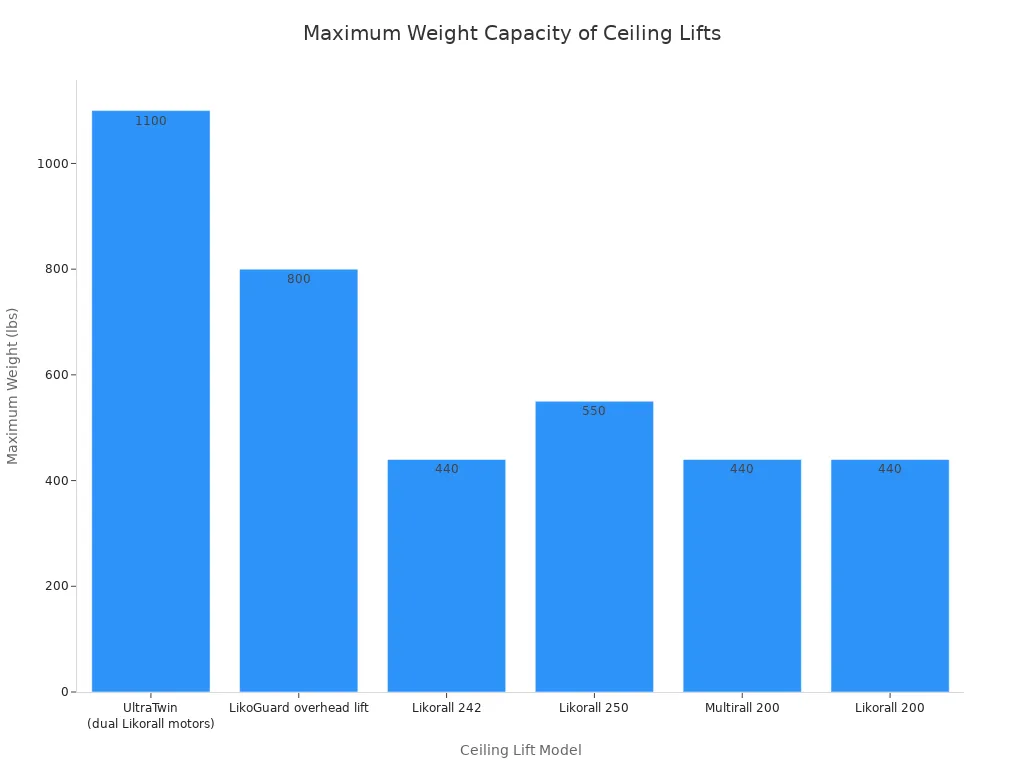
You have to match the weight capacity to what the user needs. Bariatric patients need higher limits. The table below lists the top capacities for a few models.
Ceiling Lift Model | Maximum Weight Capacity |
|---|---|
UltraTwin (dual Likorall motors) | 1,100 lbs (500 kg) |
LikoGuard overhead lift | 600–800 lbs (272–363 kg) |
Likorall 242 and 250 | 440 lbs (200 kg) or 550 lbs (250 kg) |
Multirall 200 | 440 lbs (200 kg) |
Likorall 200 | 440 lbs (200 kg) |
Always check the safe working load before you buy. Comfort counts too. Padded slings and a motor that runs smoothly help the user feel calm. A ceiling hoist rehabilitation system helps with mobility equipment training and standing practice.
Fixed vs. Portable Options
You have to pick between fixed and portable designs. Each one has its own good points.
Feature | Fixed Ceiling Hoist | Portable Ceiling Hoist |
|---|---|---|
Upfront Cost | Higher ($4,500+ including professional installation) | Lower (no permanent installation required) |
Long-term Cost | Cost-effective for long-term use and frequent transfers | Less expensive for short-term or temporary needs |
Installation | Requires professional structural assessment and mounting | Easily dismantled and reassembled; no permanent changes |
Ease of Use | Smooth, hands-free transfers with minimal caregiver effort after installation; ideal for daily, frequent transfers | Easy to carry, assemble, and move between rooms; flexible for changing mobility needs or travel |
Ideal Use | Aging in place, multiple daily transfers, keeping walkways clear | Short-term needs, travel between homes, or when relocation is likely |
A ceiling-mounted system fits setups meant to last. A portable ceiling lift is great for short-term needs or travel. Both overhead and ceiling lifts ease the strain on caregivers. Pick based on your budget, your space, and your long-term plan.
Best Ceiling Lifts for Elderly Care
GoLift and Other Top Ceiling Lifts
The GoLift is one of the most popular choices for homes and care centers. You can pick from four models. The GoLift 400 lifts 181 kg, the GoLift 450 lifts 205 kg, the GoLift 700 holds 318 kg, and the tandem GoLift 1000 can safely lift patients up to 453 kg. Each unit weighs only 4 to 5 kg and runs quietly below 55 dB. The capacitive touch hand control, emergency stop, overload protection, and soft start/stop features make every transfer smooth. A 3-year warranty gives you peace of mind.
Model | Maximum Capacity |
|---|---|
Handicare C-625 Fixed Ceiling Patient Lift | 625 lb |
FL Savaria Fixed Ceiling Lift | 440–600 lb |
Mackworth TX600 Fixed Ceiling Lift | 600 lb |
Most ceiling-mounted lifts usually hold between 300 and 450 pounds. Bariatric ceiling lifts can hold between 500 and 1,000 pounds. You should always match the weight capacity to what the user needs.
Liko FreeSpan SR and Maxi Sky 440
The Liko FreeSpan SR gets good reviews for elderly users because it stands on its own. You do not need to mount it on the ceiling. This makes it great for rentals or buildings with weak ceilings. You can adjust where it sits over the bed to keep the user comfortable. Strong 3-inch casters make the unit easy to roll around. The FreeSpan SR can lift a patient up from the floor, which helps during fall recovery. It comes with a sling and holds up to 440 lb. A 3-year warranty covers the sturdy frame.
The Maxi Sky 440 is easier to carry than most fixed systems. Unlike traditional ceiling lifts that need permanent track installation, this portable ceiling lift moves fast between rooms. It weighs only 14.3 lbs (6.5 kg) and has a carry handle. One caregiver can do transfers with a wide range of Arjo loop slings. The unit attaches quickly to gantries or tracks. Hospitals, long-term care facilities, and homes all gain from this flexibility.
Other strong choices include the Mackworth TX 600 with a 600 lb lifting capacity. When you compare brands such as Arjo, Handicare, Savaria, and Guldmann, you will find clear strengths in safety, ease of use, and installation. A ceiling hoist rehabilitation approach works best when you match the system to the user's mobility equipment needs and the room layout. Proper repositioning and regular safety checks protect both the user and the caregiver during every transfer.
QianJing Overhead Ceiling Track Hoist for Rehabilitation

QianJing Rehabilitation is a manufacturer of the Overhead Ceiling Track Hoist, a modern patient transfer and ceiling hoist rehabilitation training system. You can find this system in hospitals, rehabilitation centers, nursing homes, and elderly care facilities. This ceiling track hoist system mixes smart motor technology with flexible track setups for safe patient handling and gait training. The ceiling lift allows smooth up-and-down and side-to-side movement. One caregiver can move patients with limited mobility, which lowers the risk of manual handling. The weight capacity fits many patient needs, so it works well in rehabilitation settings. When you compare ceiling lifts, this system stands out for its smart features.
Smart Motor and Training Modes
The system gives you three training modes for different recovery stages. Early suspension mode helps with limb stretching and joint mobility. Mid-term fixed-point mode supports standing, squatting, and balance training. Late free mode lets patients walk, use stairs, handle slopes, and cross obstacles. The motion recognition technology finds your patient's movement pattern, walking speed, and direction on its own. It then adjusts system settings to match. Multiple sensors track center-of-gravity changes in real time and adjust weight reduction by themselves. This keeps support steady while reducing hands-on help. The weight capacity of this ceiling track hoist handles frequent daily use. The smart motor drives the hoist head to follow your patient in real time, which stops instability. This improves ceiling hoist rehabilitation results for neurological and orthopedic recovery.
Safety and Customizable Track Layouts
Safety comes first. The system integrates motion recognition and multiple sensors to automatically adjust parameters and maintain stability, enhancing safety during transfers. You can set up rail layouts with straight, curved, and H-track configurations. You can also use four-way, three-way, Y-shaped, and H-shaped transitions. This flexibility lets you build an x-y or h-frame system that fits your room. Many slings are available for sitting and horizontal transfers, walking training, and suspended rehabilitation. The system includes an emergency stop and emergency lowering device. Whether in a hospital or home, this ceiling or overhead lift works reliably. This overhead ceiling lift fits easily into your current care routine. This ceiling track hoist gives you consistent, safe transfers. Among ceiling lifts, this system stands out for its full range of features.
Comparison Table: Best Ceiling Lifts at a Glance
Capacity, Track Type, and Price
You need a fast way to compare the top systems. The table below lines up the main specs side by side. You can see the weight capacity, track type, and price range for each model. This helps you narrow down your choices quickly.
Model | Weight Capacity | Track Type | Price Range |
|---|---|---|---|
GoLift 1000 | 453 kg (1,000 lb) | Fixed ceiling track | $4,500+ |
Liko FreeSpan SR | 440 lb | Portable, freestanding | Lower (no permanent installation required) |
Maxi Sky 440 | 440 lb | Portable, gantry or track | Lower (no permanent installation required) |
Mackworth TX 600 | 600 lb | Fixed ceiling track | $4,500+ |
Varies by configuration | Fixed, customizable (straight, curved, H-track) | Contact for quote |
The GoLift 1000 has the highest weight capacity, so it works best for bariatric users. The Liko FreeSpan SR and Maxi Sky 440 give you portable choices. The QianJing ceiling track hoist lets you set up flexible track layouts for rehabilitation settings.
Safety and Ease of Use
Safety features and ease of use are just as important as capacity. The table below shows what each system gives you.
Model | Safety Features | Ease of Use |
|---|---|---|
GoLift | Emergency stop, overload protection, soft start/stop | Capacitive touch hand control, quiet operation |
Liko FreeSpan SR | Emergency stop, floor lift capability | Adjustable positioning, easy to roll |
Maxi Sky 440 | Emergency stop, soft start | Lightweight (14.3 lb), carry handle |
Mackworth TX 600 | Contact manufacturer for details | Contact manufacturer for details |
QianJing Overhead Ceiling Track Hoist | Motion recognition, automatic parameter adjustment, multiple sensors | Smart motor with three training modes |
The QianJing system stands out for ceiling hoist rehabilitation. Its smart motor changes to match your patient's movement. The best ceiling lifts mix strong safety with easy operation. A ceiling lift with smart features cuts down the effort for caregivers. You should pick a ceiling track hoist that fits your daily routine. For ceiling lifts used in rehabilitation, look for motion recognition and battery backup. The right ceiling lift keeps both you and your patient safe.
How to Choose a Ceiling Track Hoist
Assessing User and Space
First, look at the user's weight, mobility, rehab goals, and how often they need transfers. Ask if the patient needs full-body support, can bear some weight, or can stand with help. Map out the transfer paths you must connect, like bed to wheelchair to bathroom. Think about the rehab functions you need, such as gait following, dynamic weight reduction, standing training, and balance training. Match the sling to the patient's body position and the activity planned. Check the installation space, including ceiling structure, room size, ceiling height, and wheelchair access. Keep in mind the patient's clinical condition and rehab stage, since different mobility levels need different lifting modes and training programs.
Room layout and ceiling structure affect your track setup choice. A straight track follows a fixed line, so you must check for a predictable transfer route. A curved track is more sensitive to room layout because the direction of travel changes mid-transfer. An H-track gives you more flexibility across a wider area. Both hoist tracks and shower rails compete for ceiling or wall space. Physical limits include ceiling height, wall returns, pipework, lighting, and structural fixing points. Fix these conflicts during planning, not after installation.
Installation and Accessories
Plan your ceiling lift installation with a qualified professional. A structural assessment confirms your ceiling can hold the system. Think about a portable ceiling lift for multi-room use or short-term needs. Pick the right slings and accessories for the intended activity, such as seated transfers, walking rehabilitation, or suspended rehabilitation. Consult the manufacturer for specific sling options.
You should talk to an occupational therapist or installer before you buy. They can check your weight capacity needs and confirm stable transfers for daily transfers, lifting, and repositioning. The right ceiling lift or ceiling lifts system supports safe daily transfers. A well-chosen ceiling track hoist improves care quality for years.
The GoLift 1000 works well for bariatric users who need to lift more weight. The Liko FreeSpan SR and Maxi Sky 440 are good picks when you need something you can move around. The QianJing Overhead Ceiling Track Hoist fits rehabilitation settings because it has smart training modes. Each of these top ceiling lifts serves a different purpose. You should focus on safety, comfort, and dignity instead of just the price. A ceiling lift keeps both you and your patient safe during everyday transfers. Talk to an occupational therapist or installer before you buy. They can check your ceiling structure and track layout. The right ceiling lifts system will make your daily care routine much better.
FAQ
How do you match a ceiling lift to a patient's weight?
Check the weight capacity against what the patient weighs now. Standard models hold 300 to 440 pounds. Bariatric lifts can handle up to 453 kg. Always check the safe working load before you buy.
Is professional installation required for a ceiling track hoist?
Most fixed ceiling lifts need a pro to install them. A check of your ceiling structure makes sure it can hold the system. Portable options, like the Liko FreeSpan SR or Maxi Sky 440, are easier to set up for short-term needs.
Can a ceiling lift support rehabilitation exercises?
Yes. Systems like the QianJing Overhead Ceiling Track Hoist come with training modes. You can use it for standing, walking, climbing stairs, and balance training. Dynamic weight reduction changes the support as you move.
What safety features are essential in a ceiling lift?
You need emergency braking, anti-fall protection, and a manual backup. An emergency lowering device keeps it safe during a power outage. These features keep you and the patient safe during every move.
How does a ceiling lift reduce caregiver strain?
It takes away the physical work of lifting by hand. One caregiver can safely move or reposition a patient with the motorized system. This lowers the chance of back injuries and makes daily care easier.

